

Why were there dozens of mills in such a small valley? In Calci, at the foot of Monte Pisano, the answer is not simply “because there was water”.
The Zambra stream provided the power, but man-made channels carried its water where it was needed, supplying mills and olive presses. Behind the scenery of the Valgraziosa lay a network of activities that processed agricultural produce and provided work for the village.
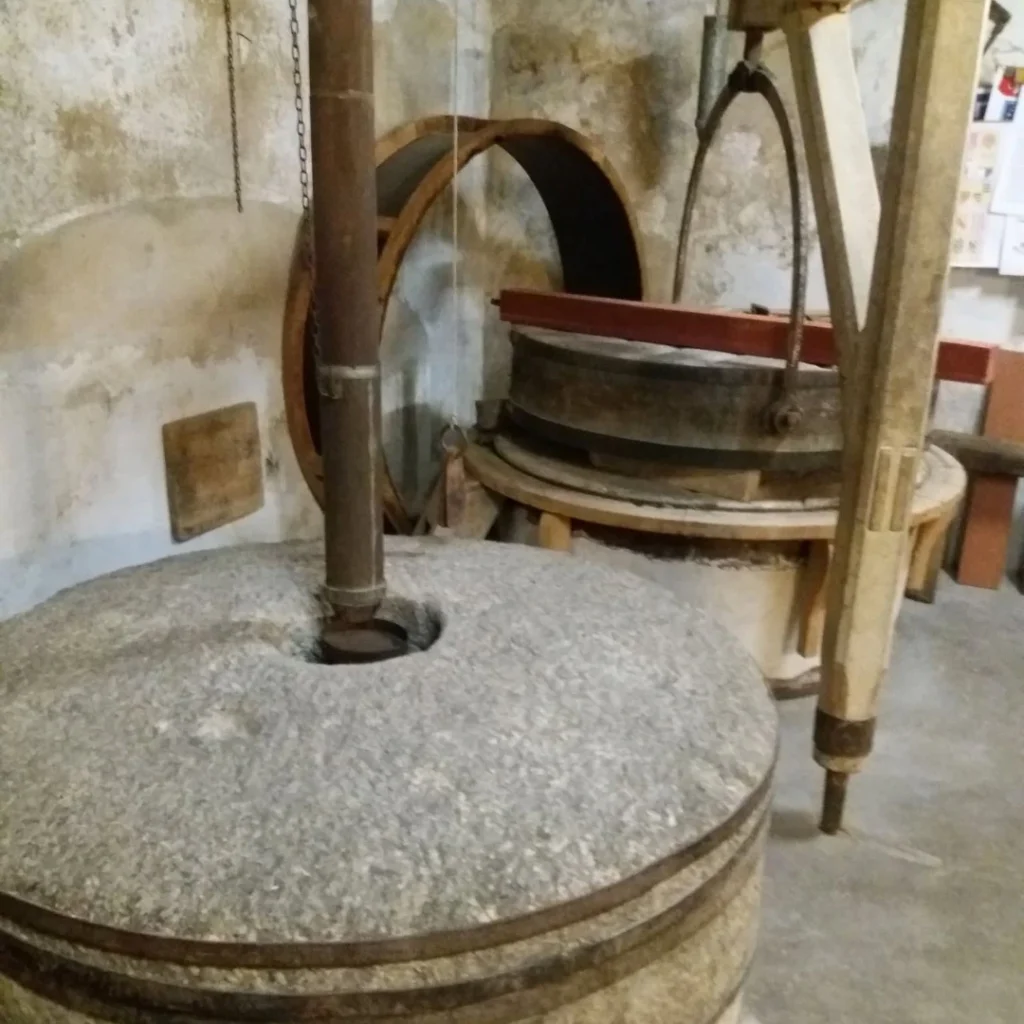
Gangalandi Mill preserves some of the clearest evidence of that past: not just a building, but millstones, gears and tools that help explain what happened when water reached the mill.
The secret was not just the stream
The presence of a watercourse alone does not explain such a concentration of activity. To harness its energy, people first had to control its flow.
In Calci, water was diverted through masonry channels known as aldii or gore, which supplied the mills and returned it to the main watercourse after its power had been used. The Aldio, the mill channel running parallel to the Zambra, was a key part of this system.
It was therefore not simply a matter of building a mill anywhere in the valley. Proximity to water, the shape of the land and the ability to power the machinery all mattered.
The buildings used for these activities were concentrated along the waterways, particularly at lower elevations. Their distribution reflects a practical choice: people worked where they could bring in the power they needed.
From chestnut woods to millstones: a valley organised around production
What grew on the mountain also helped shape the work.
Higher up, among the chestnut woods, stood the metati, small buildings used to dry chestnuts. Further down were the mills and olive presses. Different places served different stages of processing, according to the work involved and the resources available.
Calci was particularly associated with flour production, processing produce from the lowlands alongside crops from the mountain.
This offers a different way of imagining the Valgraziosa. It was not simply a countryside of fields and homes, but a landscape in which harvesting, processing and work were closely connected.
How did a watermill work?
The principle was simple: water set a wheel in motion, which powered the milling machinery. The stream’s energy was converted into mechanical work, allowing the mill to grind produce into flour.
Gangalandi Mill retains its millstones, gears and the tools used in production. Their importance lies in how they relate to one another: these are not unrelated objects brought together in a collection, but parts of a working process.
A millstone on its own tells only part of the story. A mill that retains its machinery allows us to trace the sequence from water to movement and, finally, to the finished product.
This is why Gangalandi is an example of industrial archaeology. Its value lies not in elaborate decoration, but in what it reveals about how people worked.
Gangalandi Mill: recorded in 1521, working until 1949
The mill takes its name from the Gangalandi family, who owned it in the past. Its existence is documented in 1521: a date that confirms it was already there, rather than necessarily recording when it was built.
It stands beside the Zambra in the Castelmaggiore area, along the road climbing from Calci towards Tre Colli. It remained in operation until 1949, when the death of the last miller marked the end of production.
This timeline changes how distant the place feels. We are not looking at a technique confined to the remote past: the mill was still working after the Second World War.
Then came silence. As with other mills in the valley, the end of production raised a question: what should be preserved when a building no longer serves the work it was created for?
A teacher who helped save the mill
The survival of a place also depends on the people who care for it.
Angiolo Chini, a teacher, played a decisive role in preserving Gangalandi Mill. After retiring in 1991, he devoted himself to caring for the mill and collecting tools from rural life.
His aim was to create a place that could tell the story of farming communities, rather than simply house old machinery. Over the years, school groups also came to the mill to discover that history through its objects.
In 1999, the complex was placed under historical and architectural protection, recognising its cultural significance.
While many mills were converted into homes or stripped of their machinery, here it remains possible to understand something of the work that gave them their purpose. That is the difference between preserving the walls alone and preserving the story they tell.
Following the Zambra, this time on horseback
The stream that once powered the mills can become the thread connecting a different kind of experience in the Valgraziosa.
On our sunset horse ride towards the Certosa di Calci, you set off from the riding centre and follow trails alongside the Zambra, through woodland with glimpses of the valley. The destination is the Certosa, or Calci Charterhouse, admired from the outside in the evening light.
The ride lasts approximately one hour and is suitable even for those who have never ridden before, with support from the instructor.
Back at the riding centre, you can add an aperitivo for an additional charge: a way to enjoy the afternoon a little longer rather than heading straight off.
The experience does not include a visit to Gangalandi Mill or entry to the Charterhouse. It offers another way to discover the landscape whose history we have explored, following the water rather than simply looking at it.
Discover the sunset horse ride and choose the aperitivo option
Why were there so many mills in Calci?
The Zambra and its network of man-made channels provided the power needed for processing agricultural produce. Mills and olive presses were concentrated where this resource could be harnessed, forming an interconnected system of local production.
What was the Aldio?
It was the mill channel that carried water from the Zambra to the mills. It formed part of the infrastructure built to harness the stream’s power for work in the valley.
Does Gangalandi Mill still produce flour?
Production ended in 1949. Its historical interest lies in the preservation of its millstones, machinery and working tools, rather than any current commercial production.
Can I add an aperitivo to the horse ride?
Yes. An aperitivo is available on your return to the riding centre, for an additional charge, by selecting the relevant option when booking.
Sources and further reading
The distribution of mills and the working landscape: Massimiliano Grava, Gli opifici di Calci all’impianto del “Leopoldino”: il GIS applicato all’Archeologia Industriale, in Storia e Futuro, no. 30, November 2012. Research based on cadastral records, used to explore the relationship between water channels, mills, olive presses and chestnut-drying buildings.
The mill network and changes to its heritage: Denise Ulivieri, C’era una volta un molino…, 2006. Only the abstract in the University of Pisa’s research repository was consulted, not the full publication.
The Aldio and the mill’s location: FAI, Gangalandi Mill profile, for background on the water system and the building’s location.
Timeline, machinery and protection: Museo Galileo, Mulino Gangalandi, entry by Graziano Magrini, updated in 2008 and used for historical information; Il Tirreno, Con il Fai alla scoperta dell’antico Mulino Gangalandi, 5 May 2019. The opening arrangements described on these pages do not constitute a current visiting schedule.
Local memory: Francesco Bondielli, Angiolo Chini e il “suo” molino: una storia che non va dimenticata, TuttoMondo, 13 February 2017, for the account of Chini’s commitment to preserving the mill.
Horse riding and optional aperitivo: Montepisano Travel, Passeggiata a cavallo al calar del sole – La Certosa al Tramonto, for the route, duration, instructor support and aperitivo option.


