

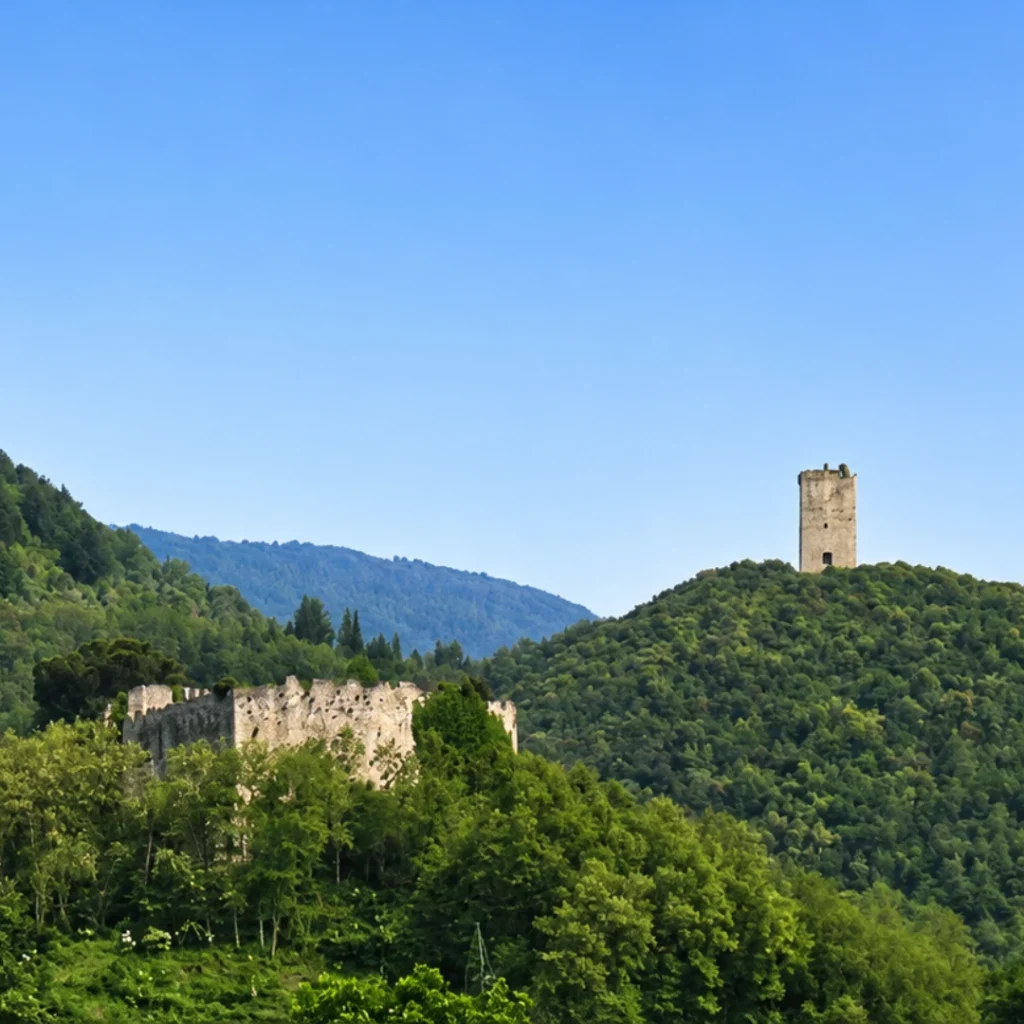
It defended Pisa’s territory, yet bears the name of Lucca’s patron saint. The Rocca di Ripafratta, also known as the Rocca di San Paolino, overlooks the village from the top of Colle Vergario. An apparently unlikely dedication for a fortress that became one of Pisa’s main strongholds against its neighbouring city.
The explanation lies in its origins: the castle was founded by the Da Ripafratta, a noble family with ties to the Bishop of Lucca, before coming under Pisan influence. The name San Paolino preserves that earlier connection.
To understand it, we need to return to a time when local lords controlled this stretch of the Serchio. Before the great battles, there was a family, a favourable position and a very practical interest: collecting tolls.
Before the rival cities, the lords of Ripafratta
Ripafratta occupies a narrow stretch of the Serchio valley, where the river and the foothills of Monte Pisano restrict the passage. Whoever controlled this point could monitor movement between Pisa and Lucca and earn revenue from road and river traffic.
The Da Ripafratta family built their fortress to strengthen their control over the area. The village, then also known as Ripa, came under the ecclesiastical authority of the parish church of Montuolo, in Lucca’s territory.
The imposition of tolls helped strain relations with Lucca. In 1104, the Lucchese attacked the lords of Ripafratta and captured the castle. The family then sought Pisa’s support, beginning a shift in alliances that would shape the site’s history.
The move to the Pisan side did not erase the fortress’s name. This overlap between its origins and later allegiances explains the apparent contradiction of San Paolino.
Why are some of the towers outside the castle?
Between the twelfth and thirteenth centuries, Pisa strengthened the fortification, turning it into a key stronghold within its defensive system. But protecting Ripafratta meant more than making the fortress walls stronger.
Other lookout structures were built on the surrounding hills. Among those that survive are Torre Niccolai and Torre Centìno, separate from the main enclosure but part of the same system.
Their position served a different purpose from that of a tower within the walls: keeping watch over the territory around the fortress. The system also included the defences of the village below, along the routes through the valley.
Ripafratta should therefore be imagined as a series of connected points, rather than an isolated hilltop castle. The fortress was the centre of a defensive network extending into the landscape: the outlying towers still help reveal its scale.
When even the entrance changed sides
Over the centuries, the castle was captured, handed over and recaptured, eventually coming under Florentine rule. In the early sixteenth century, the changing demands of warfare brought further alterations.
Firearms required different defences. The medieval towers were lowered, and sloping reinforcements, known as scarpe, were added to the bases of the walls. Additional defensive works protected the entrance.
The gateway also changed position: the medieval entrance on the Pisan side was replaced by a new one on the Lucca side. The fortification was reorganised, altering not only its outline but also the way into it.
The surviving walls therefore do not belong to a single moment in history. They preserve the adaptations of a building designed to keep defending its position.
When vegetables grew inside the fortress
The next surprise comes when the fighting ends.
As the political balance changed, Ripafratta gradually lost its military importance. In the seventeenth century, the land enclosed by its walls found a use far removed from warfare: it became a place to grow crops.
In 1628, the fortress was granted to Orazio Angelini to establish a vegetable garden and plant fruit trees and vines. Agricultural use continued, through subsequent changes, until after the Second World War.
The greenery within the fortress therefore tells a story of work, not simply abandonment. For a long time, the enclosure was used to grow food rather than defend a frontier.
Archaeological excavations begun in the 1980s later uncovered structures and evidence of life in the castle, restoring historical depth to a place that might otherwise have been seen as little more than a ruin.
From the village to the fortress: tracing the frontier through the landscape
To explore Ripafratta, in the municipality of San Giuliano Terme, start in the village. The square outside the Church of San Bartolomeo Apostolo provides an initial point of reference: San Paolino is the name of the fortress, not the parish church.
Around the square stands the building known as the Palazzo della Dogana, or customs house. A little further on is the former residence of the Podestà, the local magistrate, recognisable by its plaques bearing the Medici coat of arms. These traces of administration and control complement the military history of the hill above.
The walk can continue through Via di Sopra, Vicolo del Campanile and Via Silvestro Lega, rather than focusing solely on finding the best spot to photograph the fortress. From below, the relationship between the village, the fortress and the narrow valley becomes clearer.
The fortress itself is not freely accessible: visits take place during events organised by the local association, Pro Loco Ripafratta “Salviamo La Rocca”, with the municipality’s authorisation. The route includes uphill sections on a trail and should be distinguished from a walk around the village.
Access notice: safety work began in 2026, with a section of Via della Rocca closed until the work is completed. Before setting out, check opening arrangements and permitted routes with the Pro Loco on +39 339 8358584, also available via WhatsApp. Do not cross barriers or enter restricted areas.
To continue your day around Monte Pisano, the natural next stop is Nozzano Castle, on the other side of the Serchio. Combining the two lets you view the territory from opposing sides, while remembering that allegiances were not always fixed.
That is precisely what the name San Paolino reveals: alliances changed, while a trace of Lucca’s past remained within the Pisan fortress.
Why is the Rocca di Ripafratta also called San Paolino?
The name recalls the fortress’s origins in Lucca’s sphere of influence. It was built by the Da Ripafratta, a noble family with ties to the Bishop of Lucca. The fortress later became part of Pisa’s defensive system while retaining its dedication to Lucca’s patron saint.
Where is the Rocca di Ripafratta?
It stands on Colle Vergario, above the village of Ripafratta, in the municipality of San Giuliano Terme, in the province of Pisa, close to the border with Lucca.
Can I visit the fortress at any time?
No. Visits are organised on specific, authorised occasions. Check the Pro Loco’s programme and any restrictions relating to ongoing work and safety before travelling.
What are Torre Niccolai and Torre Centìno?
They are towers outside the fortress enclosure, once part of the system for monitoring the surrounding territory. Their positions show that Ripafratta’s defences extended beyond the castle walls.
Sources and further reading
Name and origins: Italia Nostra Pisa, La Rocca e le Mura, 31 March 2017; FAI, Rocca di Ripafratta profile, used for historical background, not for current ownership information.
Tolls, alterations and agricultural use: Pro Loco Ripafratta “Salviamo La Rocca”, La Rocca di Ripafratta: una storia millenaria.
Architecture and towers: Italia Nostra, historical and architectural profile; University of Pisa, FORTMED 2023, visit to Ripafratta.
Understanding the defensive system: Ewa Karwacka, Pisa e Ripafratta. Alcune riflessioni sulla metodologia della ricerca storica…, 2019. Only the university repository’s abstract was consulted, not the full essay.
Village and visits: Pro Loco Ripafratta, Il borgo, Domande e risposte and the 2026 Festa della Rocca programme, for information about the routes and the connection with Nozzano.
Restrictions and contact details: Municipality of San Giuliano Terme, May 2026 road and access changes, referring to municipal order 2026/140; 2026 Festa della Rocca event listing.


