
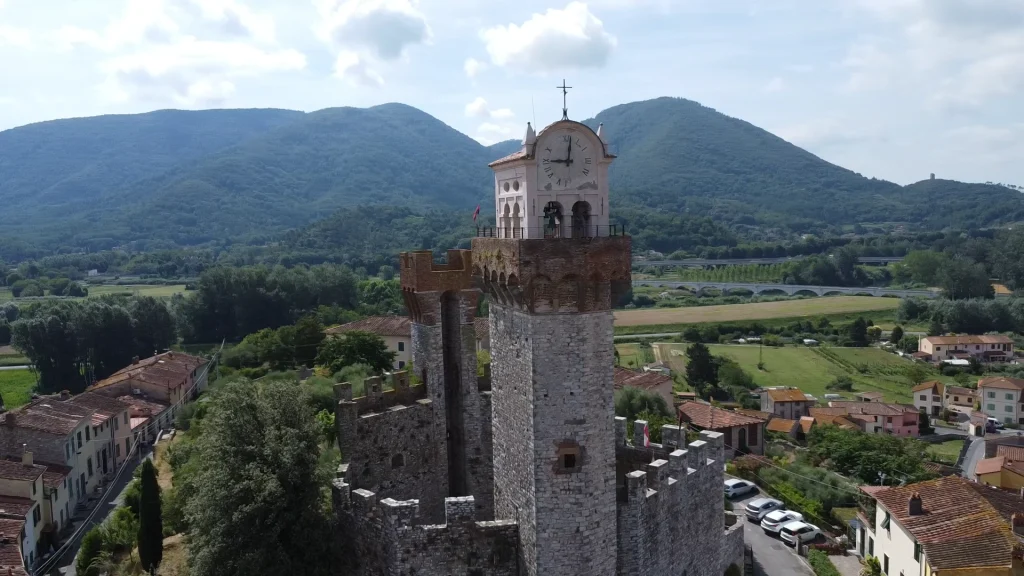
Battlements, stone walls and, at the top of the tallest tower, a structure that looks like a small church. Nozzano Castle, in the Lucca area, has a silhouette that raises a question: what is that building doing up there?
It is not a church built on top of the castle: it is the belfry of a medieval keep that was converted into a bell tower.
The answer reveals more than an architectural curiosity. Nozzano is not simply a surviving fortress: it is a place where defensive structures have found new uses in village life.
One tower, two functions
The keep, the main tower of the fortress, formed part of Nozzano’s defensive system. Its later use as a bell tower introduced a religious function alongside its military past, without erasing the earlier structure.
The effect comes from the combination of different elements: the tower itself, its projecting upper section and the roofed structure at the top. From a distance, the latter can resemble a little church perched on the fortification.
The most intriguing feature is therefore not a chapel in an unusual position, but the reuse of military architecture. The tower retains its defensive appearance, while the bells tell of a different purpose.
Nozzano’s actual church is in the village
The church itself is dedicated to San Giuseppe, or St Joseph, and stands within the fortified village. It should not be confused with the church in nearby Nozzano San Pietro. Yes, even in Tuscany, imagination sometimes runs short when it comes to place names.
The patron saint also features in a local memory. In an article published in 2019, Giuseppe Pardi recalls how Nozzano Castello celebrated the “Beppi”—the men named Giuseppe—on St Joseph’s Day. His grandfather received a sonnet on 19 March 1937 and, according to the family recollection, all the members of the committee organising the festivities were also called Giuseppe. Giuseppe Pardi, Papà o pappà?
Why build a fortress here?
Nozzano stands on a rocky hill on the right bank of the Serchio, in a strategic position for defending Lucca’s territory against Pisa. On the opposite bank is the Rocca di Ripafratta, which belonged to the Pisan defensive system. The two fortifications were opposing strongholds along the same frontier.
The fortress was attacked, destroyed and rebuilt several times. A significant date in the development of its fortifications is 1395, also commemorated by the inscription near the village entrance. This refers to the rebuilding of the defences and does not, on its own, establish when the keep became a bell tower.
The relationship between Nozzano and Ripafratta explains why the landscape is part of their history. The position of the walls was not determined solely by the shape of the land: it also allowed the strongholds to watch over disputed territory.
A castle with a village inside
The name “Nozzano Castle” encompasses two distinct elements: the fortified village, enclosed by its defensive walls, and the rocca, the inner fortress that formed its military core. This distinction is also highlighted on the website run by local residents and the Il Castello association.
This layout helps explain what makes the place distinctive. The fortification is not separate from the village: it defines its space, enclosing houses, streets, a church and a well. These features also appear in the route prepared for the 2025 FAI Spring Days.
The tower that became a bell tower belongs to this same story: that of a village that has continued to live within its own fortress.
You can even see Pisa from the walls
On clear days, Pisa’s Cathedral, Baptistery and Leaning Tower can be made out in the distance from Nozzano’s walls, along with the nearer Rocca di Ripafratta. This visual connection is mentioned in Italia Nostra’s account, and volunteers from the Il Castello association suggest looking for these landmarks from the first walkway along the ramparts.
It is also the culmination of a visit that can begin further down, at the entrance arch to the village and the inscription dated 1395. Once through the entrance, the first stop can be the main well and the Church of San Giuseppe, described as being to the left of the arch in the FAI itinerary.
Before heading up to the fortress, it is worth walking through the village streets and looking for the “chiasso”, the covered passage from which you can see the walls and towers. This helps reveal the relationship between the village buildings and the fortifications, rather than making the tower the sole focus of the visit.
When the fortress is open, the route described by the association includes the courtyard, information panels and the first walkway along the ramparts. Admission does not automatically include access to the top of the bell tower. From the walkway, however, you can spend a few minutes taking in the view and trying to spot Pisa: haze and weather conditions make a difference.
Visits to the fortress must be arranged in advance with the volunteers, via WhatsApp or text message on 370 1324116, confirming opening arrangements, the requested contribution and weather conditions. The route is outdoors, and visits depend on the association’s availability.
To continue your day around the Serchio valley and the surroundings of Monte Pisano, Ripafratta is the natural next stop: it offers a view of the same frontier from the other side. The local Fortezze di confine project also connects these sites with the Torre dell’Aquila in Filettole and Santa Maria in Castello in Vecchiano. Choose a few stops and check access arrangements, rather than turning the day into a series of hurried visits.
At the end, seen once more from below, the tower tells a different story: not a church suspended above the village, but a fortress that has found a new place in village life.
Is there really a church on top of Nozzano’s tower?
No. The medieval keep was converted into a bell tower: what looks like a small church is the structure that houses the bells.
Is the fortress always open?
Opening depends on the availability of volunteers from the Il Castello association. Contact them before visiting, bearing in mind that access to the village and access to the inner fortress are separate.


