


Imagine entering the heart of the mountain, where time flows drop by drop and the rock tells a story millions of years old. The Monticello Cave, located in Agnano, in the heart of Monte Pisano, is an amazing place that combines nature, mystery, and adventure. Rich in spectacular formations, ancient legends, and deep silences, it’s one of the most authentic experiences to have in the area. In this article, you’ll discover how to reach it, what you’ll find inside, and why it’s truly worth exploring.

Location and how to get there
The Monticello Cave opens at about 50 meters above sea level, on the northwestern slope of Monte Faeta, in the territory of Agnano, a district of San Giuliano Terme (PI). The entrance is located on private property and access is regulated by agreements with the owners, therefore visits are only possible when accompanied by authorized speleological guides, in compliance with safety and environmental protection regulations.
The path to reach the cave starts from the Agnano cemetery parking lot, following a trail through the woods that takes about 15 minutes.
According to the speleological registry and historical sources, the cavity is also known by the name “La Buca (Cortopassi)”, located near an area traditionally called “Duchess’s Bath”. The latter is a local name that might refer to an ancient wetland or presumed springs, but there are no recent official confirmations.

Cave Geology and Morphology
The Monticello Cave extends for about 70 meters inside an outcrop of cavernous limestone from the Lower Jurassic, an ancient rock formation heavily subject to karst phenomena. This type of rock, very common on Monte Pisano, slowly dissolves when in contact with slightly acidic water, forming cavities, wells, and galleries. The cave represents one of the best-preserved examples of karst morphology in the area.
The entrance to the cavity is through a vertical well about 8 meters deep, equipped with ropes and anchors to ensure safe access for visitors. Once descended, you find yourself in a large central chamber with a detrital vault and irregular floor, rich in fascinating geological formations.
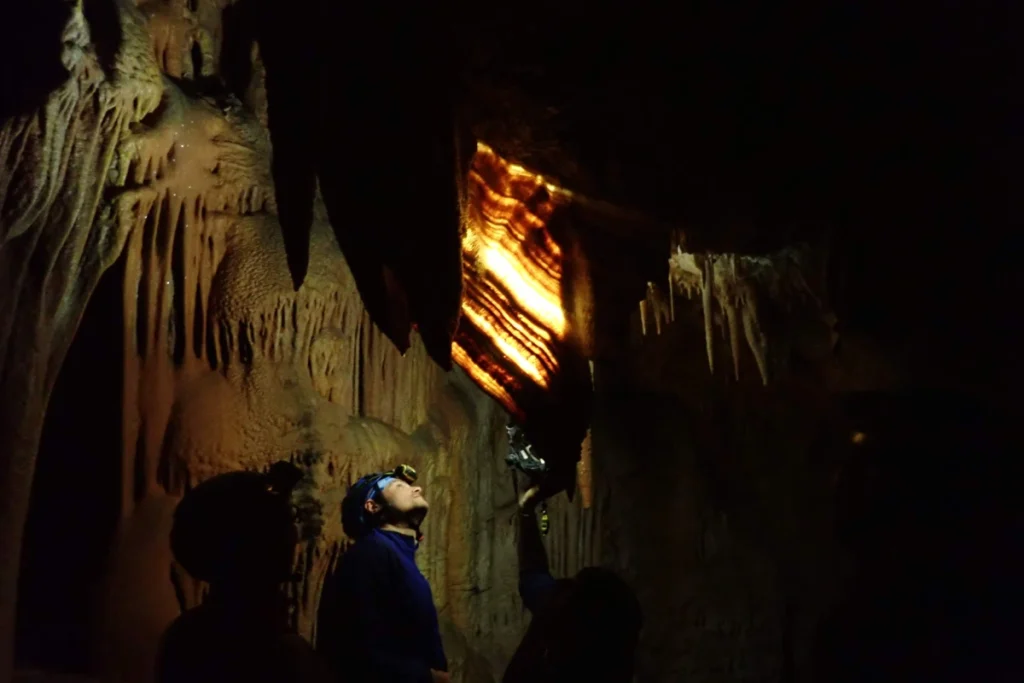
The walls are adorned with stalactites, stalagmites, columns, and draperies that have formed over thousands of years. Among the most fascinating formations are:
- The organ pipe stalactites that create surprising visual effects
- The Red Stalactite Curtain, tinted by iron oxides, one of the rarest and most photographed formations
- The “spaghetti“, a long and very thin stalactite that hangs isolated from the ceiling, representing a delicate masterpiece of nature
- Two small internal lakes that have formed in natural depressions in the ground and collect dripping water that filters through the rocks above. Their clear waters reflect the walls, creating unique lighting effects
The cave is also famous for the presence of formations that have been given symbolic names for their evocative shapes: the “Madonna and Child“, the “Baptistery” and the famous Leaning Tower, an inclined column formed by the slow deposition of calcium carbonate.
The internal temperature remains constant throughout the year, between 15 and 16°C, contributing to the stability of the microenvironment and the preservation of the formations. The humidity is high, typical of underground environments, making the visiting experience even more immersive and evocative.

History, Explorations, and Legends
The Monticello Cave was discovered in the 1920s by local farmers while working the land near the Cortopassi locality. The sudden opening in the ground and the release of vapors immediately aroused community curiosity, so much so that a few years later, in 1929, the first systematic exploration was organized by the Pisan Speleological Group. The expedition was led by Rodolfo Giannotti, a key figure in Tuscan speleology of the time, who published a detailed scientific report the following year in “Le Grotte d’Italia” magazine.
According to Giannotti’s description, the cavity appeared as “the richest and most picturesque among those known in Monte Pisano,” thanks to its abundance of concretions, play of light, and morphological variety. He also emphasized the exceptional purity and integrity of the limestone formations, never before touched by human hands. The discovery represented a significant event for local geology as well, as it revealed a previously unknown underground microcosm.
But the Monticello Cave is much more than a scientific site: for centuries it has been the subject of legends passed down orally among local inhabitants. It was said that strange voices came from the depths of the mountain, and that some animals refused to approach certain cracks in the ground. Its sinuous shapes and mysterious vapors fueled stories of earth spirits, woodland fairies, and ancient protective entities of the mountain.
Today, the cave has been made safe thanks to the intervention of speleological guides and local associations, which promote responsible visits. It has become an ideal destination for those seeking authentic experiences and wishing to connect with a hidden and fascinating side of Tuscany, where nature and memory intertwine beneath the surface.
The Guided Tour Today
The cave can only be visited through Montepisano DMC, as the entrance is on private property and access is regulated by agreements with the owners. Visits are conducted by expert speleological guides, in full compliance with environmental regulations. The experience is designed for those without previous speleological experience: before entering, a technical briefing and necessary exploration equipment are provided.
- Duration: 1.5 – 2 hours total
- Elevation difference: ≈ 60 meters (walking + vertical entrance)
- Recommended minimum age: 10 years
- Groups: maximum 10-12 people per tour
- Equipment provided: helmet, headlamp, harness, ropes
- Indicative cost: from 40 to 50 euros per person
- Reservation required on Montepisano.travel
During the visit, in addition to the actual exploration, geological, historical, and naturalistic explanations are provided. In certain periods of the year, themed visits are available, such as nighttime tours or those combined with nearby trekking, for an even more complete experience.
Join Us at the Monticello Cave on October 12, 2025
Practical Tips
Visiting the Monticello Cave is a fascinating experience but requires minimal preparation to be enjoyed at its best and with respect for the underground environment. Here are some useful tips to approach the excursion in total safety and comfort:
- Wear hiking boots with non-slip soles: the path can be wet or slippery, and cave entry is via a vertical ladder. Proper footwear is essential.
- Bring a sweatshirt or a light jacket: the temperature inside the cave remains constantly between 15 and 16 °C, even in the height of summer. It’s recommended to dress in layers to better adapt.
- Avoid bringing bulky backpacks or fragile items: the internal space is limited and the descent requires freedom of movement.
- Respect the environment: do not touch the formations (stalactites, stalagmites, and limestone formations), as they are extremely delicate and form over very long periods. Even a simple touch can compromise their growth.
- Always follow the guide’s instructions and do not stray from the group: the environment is safe, but still natural and protected.
- The experience pairs perfectly with a day of exploring Monte Pisano: you could continue with a walk in the Agnano woods, a visit to the Eremo di Rupecava, or a gastronomic stop in nearby villages like Asciano or Rigoli, to conclude the excursion with a taste of local typical products.
Five Reasons not to Miss It
- A natural masterpiece in the heart of Monte Pisano
The Grotta del Monticello is considered one of the most fascinating and well-preserved cavities in the entire Monti Pisani area, thanks to the variety and integrity of its limestone formations. A true open-air geological museum. - A journey through time in the folds of Tuscan geology
Exploring the cave means traversing layers of rock that tell millions of years of natural history. The formations and sediments offer a unique glimpse into the geodiversity of the area. - An exciting adventure, but suitable for everyone
Thanks to the accompaniment of expert guides, even those who have never practiced speleology can experience the thrill of exploring an underground environment safely, immersed in a protected and evocative setting. - An educational experience for families and schools
The visit offers the opportunity to learn in the field the principles of geology, hypogean ecology, and environmental respect. Ideal for children, teenagers, and school groups seeking out-of-the-ordinary educational experiences. - A perfect blend of nature, culture, and spirituality
Beyond the scientific wonder, the cave holds a mystical and contemplative aura. Its evocative shapes, deep silences, and the legends surrounding it make the visit a moment of authentic connection with the most hidden Tuscan landscape.

Frequently Asked Questions (FAQ)
Is speleological experience required?
Absolutely not. The visit is designed for everyone, even for those who have never set foot in a cave before. Before entering, the speleological guides provide a detailed introduction on access methods, equipment use, and behavior rules to follow inside the cavity. Everything takes place in full safety and in a relaxed and informal atmosphere.
Can children partecipate?
Yes, children from 8 years old can participate, provided they are motivated, curious, and accompanied by a responsible adult. The experience is often very appreciated by the younger ones, especially for its adventurous and immersive nature. In the case of family groups, the guides adapt the pace and content of the visit according to the participants’ ages.
Is it dangerous?
No. The entire activity is conducted with the utmost respect for safety. The cave is accessible only with a guide and the equipment used (helmets, ropes, harnesses) is certified and in excellent condition. The internal path, although suggestive, does not present particular technical difficulties for those in good physical shape.
How long does the visit last?
The total duration of the experience is about 1.5 – 2 hours, including the approach walk in the woods, the initial briefing, and the time spent inside the cave. The descent is controlled and the stay in the cave allows you to fully appreciate its natural wonders.
How do you book?
The visit can be booked directly from the Montepisano.travel website, which exclusively manages access to the cave, located on private land. Alternatively, you can contact the team via email or phone to arrange dates, times, and specific group needs.

Conclusion
The Grotta del Monticello is not just a natural cavity: it’s a gateway to a hidden, silent, and mysterious world, where every drop of water has left its mark over time, shaping the stone into surprising forms.
Visiting this cave means allowing yourself the rare luxury of slowing down, of closely observing what normally remains hidden beneath the surface. It’s an invitation to marvel, to discover the deep connection between the geology of Monte Pisano and the human stories that have intertwined around this place for centuries.
Whether you’re a nature lover, a curious traveler, or a history and science enthusiast, the Grotta del Monticello offers you a complete experience: authentic, safe, exciting, and unforgettable.
A true gem to cherish and experience, perfectly nestled in the most authentic Tuscan landscape, away from the beaten paths but close to the heart of those who love to travel with awareness.
Bibliography
- Giannotti, R. (1930). Il Monte Pisano e le sue grotte. In: “Le Grotte d’Italia”, Rivista dell’Istituto Italiano di Speleologia, Anno IV, fasc. I–II. Bologna.
- Macchi, R. (1997). Le Grotte del Monte Pisano. Quaderni del Centro di Ricerca e Documentazione Storica ed Etnografica della Valgraziosa, C.R.S.E.C. – Regione Toscana.
- Martini, G. & Molli, G. (2000). Geologia del Monte Pisano. Pisa University Press.
- Federazione Speleologica Toscana (ed.). (2010). Cavità naturali della Toscana – Catasto Regionale. Florence.


